Examining the Automotive Sector through BlueGreen Alliance Research
This is the second in a series of blogs to be published in coming weeks. Follow along to read more about BGA’s impactful research throughout the years.
By: Roxanne Johnson, BlueGreen Alliance Vice President of Research
The automotive sector is the backbone of American manufacturing. Union jobs in the auto industry have historically been a great path to the middle class for workers—especially for workers of color. The BlueGreen Alliance (BGA) has a long history of convening partners and allies to advocate for policies that support a cleaner automotive sector that maintains and creates good, union jobs across the automotive supply chain. This includes advocacy work for strong fuel economy standards, building a globally competitive electric vehicle (EV) industry, equitable buildout of EV charging infrastructure, and a focus on policies that ensure automotive workers have good, family sustaining jobs.
BGA began work on fuel economy standards for light, medium, and heavy-duty vehicles in 2010-2011, also engaging on clean fleets, transportation infrastructure, and EVs. In 2011 we supported preservation of the Advanced Technology Vehicle Manufacturing (ATVM) loan program, which we saw as critical to supporting innovation to produce energy efficient vehicle technologies in the United States.
BGA works with a set of partners and allies dedicated to advancing both labor and climate goals in the automotive sector. The United Auto Workers (UAW) and the United Steelworkers (USW) represent workers across the automotive supply chain and their expertise is invaluable to our automotive work. Together we produced a body of clean vehicles work focused on supporting strong fuel economy standards to generate demand would drive U.S. manufacturing and innovation while revitalizing the auto industry, saving consumers money, decreasing pollution, and decreasing reliance on foreign oil. Additionally, trade and economic policies and labor standards are needed to ensure that good, union jobs are created and retained in the United States. Issues of auto worker safety, misclassification, misuse of temporary workers, and benefits issues (such as tiered benefits) illustrate this need.
![]() |
![]() |
![]() |
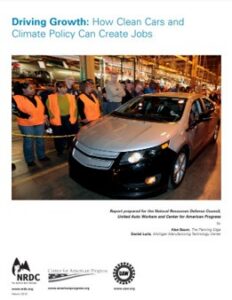
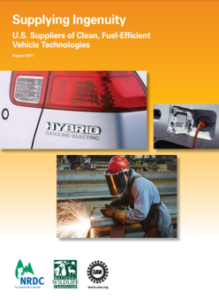
| Driving Growth: How Clean Cars and Climate Policy Can Create Jobs (2010) | Supplying Ingenuity: US Suppliers of Clean Fuel Efficient Vehicle Technologies (2011) | Gearing Up: Smart Standards Create Good Jobs Building Cleaner Cars (2012) |
| Alan Baum, Michigan Manufacturing Extension Partnership (MI MEP) for the Natural Resources Defense Council (NRDC), Center for American Progress (CAP), UAW | NRDC, National Wildlife Federation (NWF), UAW; supplier data collected by Alan Baum | BGA, American Council for an Energy-Efficient Economy (ACEEE) with the Union of Concerned Scientists (UCS), NRDC, NWF, UAW, Sierra Club; modeling by Skip Laitner |
| Modeled expansion or first application of 15 technologies and components for fleet to meet more stringent fuel economy standards to calculate jobs | Identified manufacturing facilities that make 13 categories of fuel economy products modeled to meet 2015-2025 standards, reported employment at those facilities | Modeled vehicle costs and fuel savings to implement 2017-2025 fuel economy standards to calculate consumer savings and jobs |
![]() |
![]() |
![]() |
| Supplying Ingenuity II: US Suppliers of Clean, Fuel-Efficient Vehicle Technologies (2017) | Driving Investment: Fuel Efficiency is Rebuilding American Manufacturing (2018) | Tech @ Risk: The Domestic Innovation, Technology, Deployment, Manufacturing, and Jobs at Risk in Stepping Away from Global Leadership on Clean Cars (2019) |
| NRDC, BGA, Alan Baum | BGA | BGA, UCS did some analysis |
| Update to first report; identified facilities that make 11 categories of fuel economy products modeled to meet standards through 2025, reported employment at those facilities | Reframes “costs” of fuel economy standards to critical and robust reinvestments of $76 billion over last decade in over 100 auto plants across the country | Analysis calculates jobs lost/foregone because of fuel economy standard rollbacks, compares to similar analyses, then shows which facilities make specific products in 5 categories and 37 products |
In 2017, the Supplying Ingenuity II report generated the first version of the BGA automotive supply chain data. Initially focused on manufacturers of fuel efficiency technologies, we then added assemblers, major suppliers, parts and materials inputs, and infrastructure to more comprehensively capture the entire automotive supply chain. Our automotive data includes EVs and the EV supply chain, the internal combustion engine (ICE) supply chain, and “fuel agnostic” components like tires and windshield glass and serves our work across the automotive sector. This data and interactive map was most recently updated in 2025.
Two illustrative examples of BGA comments that utilize our automotive data include our 2023 Comments to the EPA on the Proposed Pollution Standards for Light and Medium Duty Vehicles and Comments to the EPA on the Greenhouse Gas Standards for Heavy-Duty Vehicles. These comments include maps of zero emissions vehicle (ZEV), fuel economy, and pollution reduction technologies as well as the broader vehicle manufacturing supply chain. For the most recent round of fuel economy standards work, we produced a blog series on the importance of clean vehicle standards (2024).
In 2018, our focus shifted to building a globally competitive electric vehicle (EV) industry. BGA produced a body of work around mitigating losses of ICE manufacturing jobs, opportunities for the United States to capture more of the global EV market, and the associated need to capture more of the supply chain domestically, EV batteries in particular. Our focus on job quality remained, with the added challenge that historically, the clean energy industry—including EV battery production—tended, unnecessarily, to create low-road, non-union jobs. The reports produced on EVs helped align our partners and define our coalition’s message on the EV transition by demonstrating the implications of industrial policy to ensure good jobs are retained and created in the automotive sector in a transition to EVs.
![]() |
![]() |
![]() |
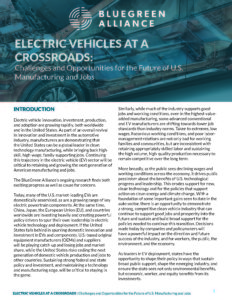
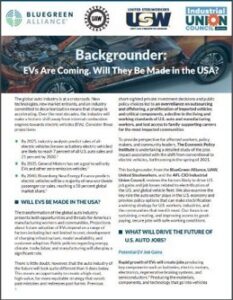
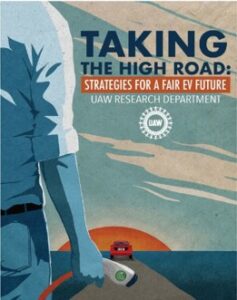
| Taking the High Road: Strategies for a Fair EV Future (2018) | EVs At A Crossroads: Challenges and Opportunities for the Future of US Manufacturing and Jobs (2018) | EV Backgrounder: EVs Are Coming. Will They Be Made in the USA? (2021) |
| UAW | BGA | BGA, UAW, USW, AFL-CIO Industrial Union Council (AFL IUC) |
| Outlines coming shift to EVs, frames as opportunity to reinvest in U.S. manufacturing if combined with proactive industrial policy to ensure high-quality jobs. Detailed overview of EVs and how they differ from internal combustion engine (ICE) vehicles, challenges (ICE manufacturing supply chain) and opportunities that need to be addressed in industrial policy. | Report makes the case that the United States has an EV supply chain but needs ongoing policy to drive competitiveness, maintain jobs and job quality. Shows diagram of EV sales; map of facilities in EV manufacturing supply chain (from BGA auto data) | Released ahead of Economic Policy Institute (EPI) report as a preview/framing; covers factors likely to drive U.S. job gains and job losses related to electrification of vehicles for the industry and broader economy. Focus on maintaining/creating good, safe jobs. These factors are the considerations going into the modeling for the EPI report. |
![]() |
![]() |
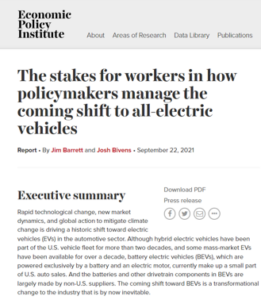
| Economic Policy Institute (EPI) Light Duty Report
The Stakes for Workers in How Policymakers Manage the Coming Shift to All-Electric Vehicles (2021) |
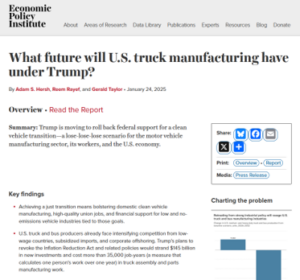
EPI Heavy Duty report
What future will U.S. truck manufacturing have under Trump? (2025) |
| EPI, Jim Barrett, with BGA, UAW, USW, AFL IUC | EPI with BGA, UAW, USW, AFL |
| Reports likely employment and job-quality implications of a large-scale shift to light duty battery electric vehicles (BEVs) under various scenarios modeled in IMPLAN that are shaped by policy, including manufacturing/domestic content and trade policies. | Reports likely employment and job-quality implications of a large-scale shift to heavy duty BEVs under various scenarios modeled in IMPLAN that are shaped by policy, including manufacturing/domestic content and trade policies. |
During the Biden-Harris administration, BGA responding to requests for information (RFIs) from federal agencies tasked with implementing programs funded by the Bipartisan Infrastructure Law (BIL) and the Inflation Reduction Act. Our comments combined the deep industrial policy expertise of our staff with the expertise and real-world experience from our partners to articulate specific recommendations on how to ensure programs create and maintain good jobs and a robust, clean manufacturing sector in the United States. We also developed resources for folks applying for BIL and Inflation Reduction Act programs in our Resource Center. Broader manufacturing work is discussed in another blog here.
Some illustrative examples of BIL/Inflation Reduction Act comments and guidance:
- Comments and recommendations in response to the Federal Highway Administration’s Request for Comment on the National Electric Vehicle Infrastructure (NEVI) Formula Grant Program in the BIL as well as guidance for the associated State EV Infrastructure Deployment Plans focused on supporting workers installing charging infrastructure across the country (2022)
- Comments and recommendations in response to the Treasury and IRS Request For Comments on the Inflation Reduction Act Amendments to the Clean Vehicle Tax Credit (30D) (2022) in the Inflation Reduction Act as well as an overview blog (2023). We highlighted the importance of the battery component and critical mineral requirements plus the North American final assembly requirement to ensure job creation, rebuild auto manufacturing communities across the country, and secure an essential supply chain for climate action.
- S. Department of Energy Request for Information on the Domestic Manufacturing Conversion Grant Program (2023) and focus on Small & Medium-Sized Manufacturers (2024). Our comments outline how the program can target investments and serve its function to redress harms inflicted on auto workers and their communities by poor trade, labor, industrial policies, and disinvestment of the past. We cite analysis from our automotive supply chain data, specifically the ICE manufacturers.
- Our blog on Buy America waivers for EV chargers (2023) breaks down what Buy America policies do, why they are important, and how waivers can be strategically used to maximize the impact of such policies.
In 2023, we partnered with Atlas Public Policy to develop the EV Jobs Hub to track new EV manufacturing jobs being announced and details about what those jobs will look like. We operated that tool through August 2026. We also produced a report Tracking the State of U.S. EV Manufacturing (2025) that documented how federal incentives in BIL and Inflation Reduction Act were generating growth in the domestic EV supply chain, outlined gaps that remain, and highlighted the importance of job quality. BGA also contributed to two Atlas case studies on Ultium Cells (2024; note that other Ultium facilities later had significant layoffs as a result of the One Big Beautiful Bill Act) and Ascend Elements (2025) that highlighted the impact of these federal incentives on workers, the local community, and the U.S. EV supply chain.
We completed our most recent auto data release in January 2025 and highlighted how our supply chain information could be used to see the impacts across the country of a repeal of the 30D EV Tax Credit, which happened in the One Big Beautiful Bill Act (OBBBA). As we move forward, BGA will continue our deep-rooted work to advocate for better policies because we understand the importance of the automotive sector to the U.S. economy, automotive workers, and their communities.
About This Series
The BlueGreen Alliance exists in a unique space in the movement for good jobs in a clean economy and our coalition has a wealth of knowledge, expertise, and experience in the areas in which we work. BGA research is developed by staff across the organization and equips partners and allies with robust data and analysis to support our shared work towards a clean, prosperous, and equitable economy. Our dedicated Research Department leverages our expertise to generate robust, evidence-supported research and data products and to inform data-driven analysis and policy recommendations.
As we celebrate our 20th anniversary in 2026, this four-part blog series reflects on 20 years of research at the BlueGreen Alliance.
Part 2: Automotive Sector
Part 3: Impactful Jobs Studies
Part 4: Tracking the Clean Economy