

Research
For 20 years BGA has been publishing important research reports and studies on everything from clean energy investments to infrastructure build out.
General Federal Policy
Employment Impacts of New U.S. Clean Energy, Manufacturing, and Infrastructure Laws
 This analysis by the Political Economy Research Institute (PERI) at the University of Massachusetts-Amherst was commissioned by the BlueGreen Alliance and National Skills Coalition (NSC). The report estimates that the combined investments in the Bipartisan Infrastructure Law (BIL), Inflation Reduction Act, and CHIPS and Science Act (CHIPS) would support nearly 3 million jobs per year over the life span of the laws. In total, the research shows the investments will support 19 million job-years.
Released: September 18, 2023
Unprecedented Opportunity: Meeting the Workforce Demands of New Clean Energy, Manufacturing, and Infrastructure Investments
 This report from the University of Massachusetts Amherst Political Economy Research Institute (PERI) examines labor supply, demand, and potential shortages from new U.S. clean energy, manufacturing, and infrastructure laws: the Inflation Reduction Act, Bipartisan Infrastructure Law, and CHIPS and Science Act. The analysis was commissioned by the National Skills Coalition (NSC) and BlueGreen Alliance and it builds on a PERI analysis from 2023 that found the combined investments in the three laws will create and support nearly 3 million jobs per year over their lifetime.
Released: February 28, 2024
9 Million Jobs from Climate Action: The Inflation Reduction Act
 An analysis commissioned by the BlueGreen Alliance from the Political Economy Research Institute (PERI) at the University of Massachusetts Amherst found that the more than 100 climate, energy, and environmental investments in the Inflation Reduction Act will create more than 9 million good jobs over the next decade—an average of nearly 1 million jobs each year. That includes more than 6 million jobs created over the next 10 years by grants, loans, and tax credits and nearly 3 million jobs stimulated by new loan guarantee authority for the U.S. Department of Energy. The bill’s broad investments will also help sustain the millions of existing jobs in the clean economy.
Released: August 2022
Then and Now: Worker Safety Under the Trump and Biden-Harris Administrations
 This report compares the worker safety policies of the first Trump administration to those of the Biden-Harris administration. The track record clearly illustrates that the first Trump administration endangered workers at every turn, consistently signaling to companies that the government would not punish them for threatening the safety and health of their employees. We can also see a dramatic shift from the Biden-Harris administration. President Biden and Vice President Harris consistently prioritized worker safety and implemented numerous policies to make workplaces safer and healthier and increase oversight of companies and employers.
Released: April 26, 2024
Then and Now: U.S. Manufacturing Under The Trump and Biden-Harris Administrations
 Taking a critical look at the industrial policies of the Biden-Harris administration and the first Trump administration, we see a dramatic shift. On several points—including job creation, investment in manufacturing, investment in cleaning up industrial emissions, and domestic momentum in growing industries—we see that the Biden-Harris administration outperformed the Trump administration.
Released: August 20, 2024
Misled: The Impact of the Trump Administration’s Agenda on Working Families and the Environment
 This report provides workers and others with the information they need to understand the impact of the policies of the first Trump administration on working families and the environment. For the purposes of this report, the impacts of some of the most egregious actions on workers’ rights and safety, environmental protection, job creation, and pandemic response are reviewed. This report sheds light on the first Trump administration’s actions that have negatively impacted working families, communities, and workplaces.
Released: September 17, 2020
Bait and Switch: The Impacts of Trump Administration Policies at the Intersection of Clean Energy, Manufacturing, and Labor
 BlueGreen Alliance (BGA) research has found that largely due to the One Big Beautiful Bill Act (OBBBA), 223 manufacturing, clean energy, and industrial projects are already facing cancellations and delays representing at least $82.8 billion in capital investment which could cost 111,765 jobs.
Additionally, more than 3,034 manufacturing, clean energy, and industrial sites face tax restrictions due to OBBBA, putting at risk $695.2 billion in capital investment and 1,184,996 jobs.
Released: July 14, 2026
Rebuilding Green: The American Recovery and Reinvestment Act and the Green Economy
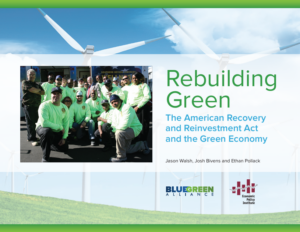 The Recovery Act’s green investments committed through the end of 2010 create or save nearly 1 million jobs, according to a report from the Economic Policy Institute and the BlueGreen Alliance.
This report shows the Recovery Act succeeded in responding to the nation’s economic crisis and that green investments create jobs while laying a foundation for the development of a 21st century economy in the United States.
Released: February 17, 2011
The Economic Benefits of a Green Chemical Industry in the United States
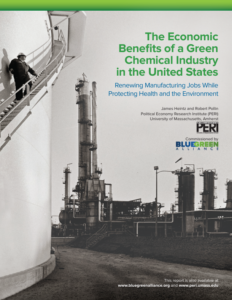 The BlueGreen Alliance released a report thats shows, for the first time, that federal chemical policy reform can support job creation in the U.S. chemical industry while protecting public health and the environment. The study, produced by the Political Economy Research Institute (PERI) and commissioned by the BlueGreen Alliance, shows that innovation in sustainable chemistry can reverse the industry’s job shedding trend in a market that increasingly requires cleaner, safer production.
Released: May 12, 2011
A Common Position on the Future of Oil
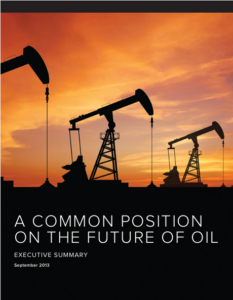 Over a fifteen-month period stretching from June 2011 to August 2012, oil refinery workers and environmentalists came together to discuss the future of oil. In four roundtables held at United Steelworkers (USW) Local offices near refinery communities in California, Louisiana, Washington and Texas, 97 people—mostly refinery workers represented by the United Steelworkers and members of local Sierra Club chapters—participated in the drafting of a common position on the future of oil.
Released: September 27, 2013
Clean Energy
Making Clean Deliver
 This report highlights research that shows increasing wages and growing domestic content in the clean energy sector would not dramatically impact costs or deployment. Job-quality concerns can be addressed and improved through the enactment of strong policy mechanisms, such as labor standards to ensure that jobs being created are high-quality jobs; procurement standards to ensure that investments being made in the clean economy are benefiting workers here in the United States; and manufacturing policies to help ensure we lead in building the next generation of clean technology in America.
Released: August 6, 2021
Energy Efficiency Should be Made in the United States
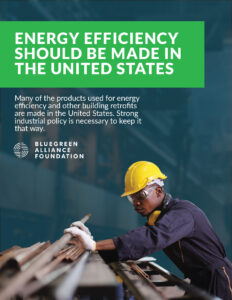 An analysis from the BlueGreen Alliance Foundation identified a decline in domestic manufacturing of energy efficiency products. In 2007, 84% of energy-efficient products used in the U.S. were manufactured domestically. The data found that today the U.S.-made percentage has fallen to 79%. The report, Energy Efficiency Should be Made in the United States, showed the U.S. share of energy efficiency manufacturing is still strong, however the decline is a cause for concern. The biggest declines seen in Appliances (11%) and Heating, Ventilation, Air Conditioning, and Cooling (HVAC) systems (10%).
Released: December 13, 2023
Manufacturing Efficiency: How Buy America Policy Can Boost Jobs Manufacturing Energy-Efficient Products
 Manufacturing Efficiency: How Buy America Policy Can Boost Jobs Manufacturing Energy-Efficient Products, compares the manufacturing job creation potential of strengthening all retrofits to full deep retrofits, increasing the retrofit rate, and implementing Buy American policies. The report found increasing the rate of residential deep retrofits across the nation coupled with the implementation of Buy American procurement policies could create more than 170,000 American manufacturing jobs.
Released: February 3, 2021
How to Revitalize America’s Middle Class with the Clean Energy Economy
 This report from the BlueGreen Alliance shows that more than 850,000 manufacturing jobs at firms already in existence across all 50 states could be created with the enactment of a national Renewable Electricity Standard (RES) of 25 percent by 2025.
The report, which is an update of an earlier analysis, estimates state-by-state the number of jobs that could be created with the installation of 18,500 megawatts (MW) per year of wind, solar, geothermal and biomass plants, which is the rough equivalent to the supply delivered under a 25 percent by 2025 RES. The report also details the potential job growth in all 50 states in each of four renewable industries.
Released: June 15, 2009
Winds of Change: A Manufacturing Blueprint for the Wind Industry
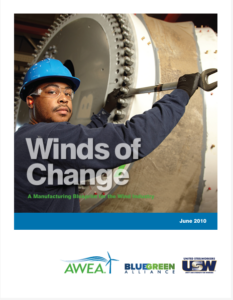
This report from the American Wind Energy Association, BlueGreen Alliance and United Steelworkers shows the U.S. wind industry can create tens of thousands of additional jobs manufacturing turbines and turbine components if the U.S. passes long-term policies that create a stable market for the domestic wind energy supply chain.
Released: June 28, 2010
The New Math for Wind and Solar Manufacturing Supports Good Jobs and US Manufacturing
Researchers at Dartmouth and Princeton released a BlueGreen Alliance-funded report on the estimated impacts the Inflation Reduction Act will have on the U.S. wind and solar industry, including changes in wind and solar manufacturing, labor standards for clean energy workers, job creation, and demand for materials. Specifically, the report explores the impacts of the law’s clean electricity production and investment tax credits (PTC and ITC) and the 45x Advanced Manufacturing Production Tax Credit.
Released: June 9, 2023
Manufacturing and Industrial Policy
Supplying Ingenuity II: U.S. Suppliers of Key Clean, Fuel-Efficient Vehicle Technologies
 Supplying Ingenuity II: U.S. Suppliers of Key Clean, Fuel-Efficient Vehicle Technologies investigates the real companies and jobs in this sector today. Our research finds more than 1,200 U.S. factories and engineering facilities in 48 states— and 288,000 American workers—building technologies that reduce pollution and improve fuel economy for today’s innovative vehicles, from family sedans to long-haul tractor trailers.
Released: May 23, 2017
Driving Investment: How Fuel Efficiency is Rebuilding American Manufacturing
 This report illustrates that the “costs” of compliance with fuel economy standards represent added automaker spending on product and manufacturing innovation, additional investments in factories and technology, and purchases of additional and upgraded components from suppliers. In turn, these costs represent a much-needed, multi-billion dollar reinvestment in American manufacturing and jobs nationwide.
Released: January 25, 2018
Electric Vehicles at a Crossroads
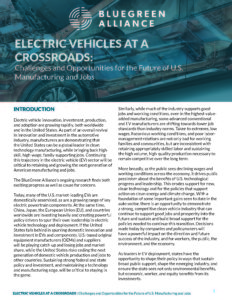
Electric vehicle innovation, investment, production, and adoption are growing rapidly, both worldwide and in the United States. As part of an overall revival in innovation and investment in the automotive industry, manufacturers are demonstrating that the United States can be a global leader in clean technology manufacturing, while bringing back high-skill, high-wage, family-supporting jobs. Continuing this trajectory in the electric vehicle (EV) sector will be critical to retaining and growing the next generation of American manufacturing and jobs. The BlueGreen Alliance’s research finds both exciting progress as well as cause for concern.
Released September 12, 2018
Aluminum, Revitalized: Strengthening the Backbone of Our Clean Economy
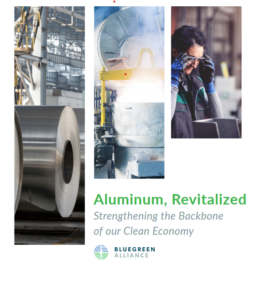 Aluminum, Revitalized: Strengthening the Backbone of Our Clean Economy is a comprehensive report on how to reverse the recent decline of the U.S. aluminum industry to meet rising aluminum demand for clean energy while creating good-paying jobs, strengthening national security, and reducing industrial emissions. The report highlights how federal investments in the Inflation Reduction Act, the Bipartisan Infrastructure Law, the Defense Production Act, and more can be leveraged to reopen aluminum smelters and retrofit facilities for cleaner manufacturing processes.
Released June 27, 2023
What future will U.S. truck manufacturing have under Trump?
 This report, a joint project with the Economic Policy Institute, explores the impacts of the Trump administration’s efforts to roll back support for a clean vehicle transition on the heavy-duty vehicles sector.
Released: January 24, 2025.
The stakes for workers in how policymakers manage the coming shift to all-electric vehicles
 This report, which the BlueGreen Alliance collaborated with the Economic Policy Institute to produce, finds that if this shift to battery electric vehicles (BEVs) is done without any policy efforts to shore up U.S. leadership in BEV production or to enhance job quality and equitable access to good jobs, then this sector will see employment decline and job quality continue a downward march. But if the shift to BEVs is accompanied by strategic investments in manufacturing and job quality in the U.S. auto sector, then the number and quality of jobs can rise together with BEV production.
Released: September 22, 2021
Read the full report here (external link).
TECH@Risk: The Domestic Innovation, Technology Deployment, Manufacturing, and Jobs at Risk in Stepping Away from Global Leadership on Clean Cars
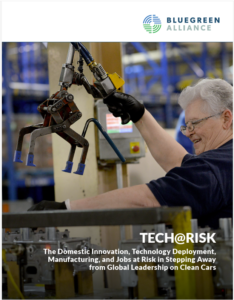 In this report, we unpack these topline statistics and look in detail at the impact of less stringent standards on demand for clean vehicle technologies and the companies that build them. We look both at today’s vehicle technology manufacturing jobs that may be impacted if standards are weakened, and estimate the impact on future jobs and job growth in the industry.
Our analysis vividly illustrates that—regardless of the modeling approach used—flatlining the standards in 2020 dramatically slows adoption of advanced technologies in almost every vehicle subsystem and cuts demand for products made by hundreds of manufacturers and hundreds of thousands of workers all across the country.
Released: August 1, 2019
The High Road to California EV Goals: Raising Ambition for High- Quality Domestic Manufacturing Jobs
This report offers a unique contribution to the debates surrounding the role of high-quality jobs and domestic manufacturing in the EV transition. The industry forecasts and analyses herein show that, if structured appropriately, domestic manufacturing goals in the form of a domestic assembly Buy America policy would not be detrimental to state environmental goals. This report also finds that a Buy America incentive policy would create tens of thousands of high-road, high-quality manufacturing jobs in-state and in-country.
Released: July 1, 2021
Potential Impacts of Electric Vehicle Tax Credit Repeal on US Vehicle Market and Manufacturing
This report from the Princeton University ZERO Lab revealed potentially devastating impacts on the U.S. auto industry if federal regulations and tax credits related to clean vehicle adoption are repealed. The report shows that in the absence of these federal initiatives, auto manufacturing from assembly down through the supply chain would face significant losses.
Released: March 11, 2025
One Year of Trump Administration and Congressional Attacks on Clean Energy Jobs and Innovation

The BlueGreen Alliance developed a comprehensive white paper and data dashboard outlining the funding cuts the Trump administration and the GOP Congress have made to clean energy and advanced manufacturing in the last year. During 2025, several administrative and congressional actions cut federal funding to advanced manufacturing projects and the clean tech industry. Notably, in July, Trump signed the GOP budget bill repealing nearly $550 billion in funding that would have supported good union jobs, clean energy, and manufacturing investments.
Released: January 14, 2026
Infrastructure
Making the Grade 2.0
This report analyzes the jobs and environmental impact of raising the American Society of Civil Engineers’ (ASCE) Infrastructure Report Card grades in a variety of sectors to “B” grades over the next decade.
The report found that investing an estimated $2.2 trillion in America’s infrastructure in these sectors to improve them from a “D+” grade overall to a “B” grade—coupled with investments in our natural gas distribution systems—has the potential to support or create an additional 14.5 million job-years across the U.S. economy, add a cumulative $1.66 trillion to Gross Domestic Product (GDP) over 10 years, and reduce greenhouse gas pollution, versus a business as-usual approach.
Released: September 7, 2017.
Interconnected—The Economic and Climate Change Benefits of Accelerating Repair and Replacement of America’s Natural Gas Distribution Pipelines
 This report from the AFL-CIO and the BlueGreen Alliance highlights the economic and environmental benefits of repairing America’s natural gas distribution systems sooner, rather than later.
Released: July 23, 2014.
Plugging the Leaks 2.0
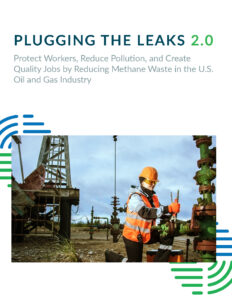 This analysis finds positive employment impacts from meeting methane standards in the EPA’s supplemental methane rule released in November 2022. These employment impacts are due to investments in emissions reduction technologies—specifically in leak detection and reduction systems, which are more labor intensive than current leak detection technology and practices used by the oil and gas extraction industry. This drives greater employment opportunities compared to the normal, business-as-usual oil and gas operations. The assessment found that over 10,000 net direct and indirect jobs would be created annually in a variety of sectors, including manufacturing, construction, and operations and maintenance through compliance with the rule. With full and continuing adoption of leak reducing technologies and practices at new, modified, and existing oil and gas facilities, this would suggest the creation of over 136,000 job-years through 2035.
Released: July 25, 2023.
Gauging Growth—The Freight Rail Supply Chain and Job-Creation Potential
 Gauging Growth shows expanding freight rail presents a significant opportunity to support and create quality U.S. jobs while improving the efficiency of freight movement and ensuring the nation remains competitive in the 21st century global economy.
Released June 15, 2011.
Full Speed Ahead - Creating Green Jobs Through Freight Rail Expansion
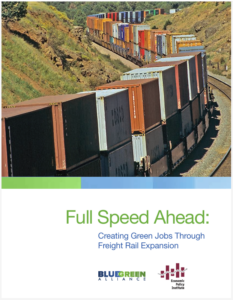
Moving to a clean energy economy that reinvests in American industries and prioritizes efficient energy use and pollution reduction represents a significant opportunity to create jobs and promote sustainable economic growth. The freight rail industry can be a part of this transition, having demonstrated its green potential by making significant strides in efficiency, limiting pollution and creating and sustaining quality jobs.
Full Speed Ahead estimates that 7,800 green jobs are created for every $1 billion of freight rail capital investment. Furthermore, the industry has nearly doubled the amount of goods it has shipped without increasing fuel consumption over the past three decades, and creates a fraction of the pollution of other transport modes such as trucking and aviation.
Released: May 4, 2010
Networking the Green Economy: How Broadband and Related Technologies can Build a Green Economic Future
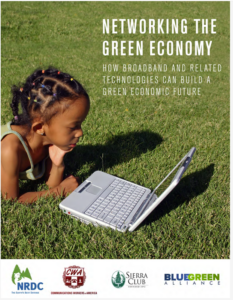 The BlueGreen Alliance, along with our partners at Speed Matters, National Resources Defense Council, and Sierra Club, released a joint report, Networking the Green Economy: How Broadband & Related Technologies Can Build a Green Economic Future.
Broadband and information communication technologies have the potential of revolutionizing energy management and economic development. In order to reduce energy, new communication technologies can be an important tool to better monitor and more effectively use natural resources. Advanced communications, including a more robust wired and wireless web, will play an essential role in facilitating and integrating these technologies.
Released: June 30, 2011
Protecting Workers and Communities
Clean Sweep: How a New Approach to Cleaning Commercial Building in the Twin Cities can Protect Our Health and the Environment While Securing Jobs and Saving Money
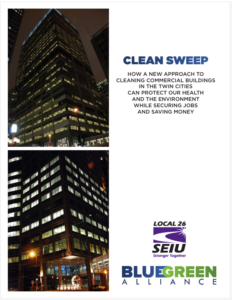 This report by the BlueGreen Alliance and Minneapolis-based SEIU Local 26 examines the benefits of a shift to Day Shift and Green Cleaning in our nation’s commercial office buildings to our environment and our economy.
Global warming and toxic chemical hazards are widely acknowledged to be the biggest environmental challenges of our time. Climate change is already affecting the Great Lakes region, with average annual temperatures rising, severe rainstorms becoming more frequent, winters getting shorter, and the duration of lake ice cover decreasing.
Released: January 26, 2010
America’s Energy Transition: A Case Study in the Past and Present of Southwestern Pennsylvania’s Power Sector
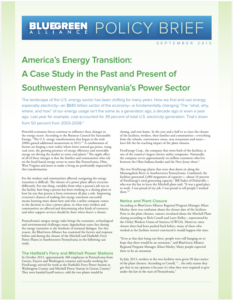 Pennsylvania’s unique energy stake brings the economic, technological and environmental challenges many Appalachian states face during the energy transition to the forefront of national dialogue. For this reason, the BlueGreen Alliance has examined the factors and response before and during the closure of the Mitchell and Hatfield’s Ferry Power Plants in Southwestern Pennsylvania in the following case study.
Power Stations shutdowns in southwestern Pennsylvania offer lessons on how good policies can protect workers, build up the local economy, and ensure that no one is left behind in this energy transition.
Released: September 30, 2015
Less Exposure and More Protection: What We Can Do Now to Protect More Black and Brown Workers’ Lives
 Released at the height of the COVID-19 pandemic, this paper looks at how the coronavirus pandemic upended lives. The enormity of this pain, however, has not been borne equally. Latinx and Black Americans were three times as likely to become infected as their white neighbors and nearly twice as likely to die from the virus as white people. The paper shows that the twice as high death rate for Black and Latinx people could be reduced by mandating COVID-19 safety protections at their jobs.
Released: July 29, 2020.
California Contra Costa Refinery Transition Partnership Report and Policy Recommendations
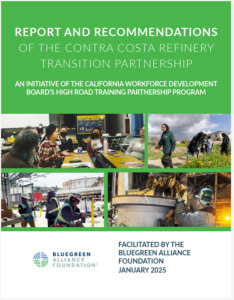 In 2020, the Marathon Martinez oil refinery in Contra Costa County, California, announced that it would indefinitely idle, laying off over 700 workers, including 350 members of the United Steelworkers Local 5. This refinery closure acted as a wake-up call for Contra Costa County, the oil refining hub of Northern California. The closure prompted local labor and environmental justice organizations to come together to form the Contra Costa Refinery Transition Partnership (CCRTP), building on more than a decade of collaboration between environmental justice groups and refinery worker unions to advocate for accountability and stronger refinery safety measures.
Released: January 14, 2025
Obstructing the Right to Know: A Bluegreen Alliance/Clearya Analysis Of The Chemical Industry’s Health Hazard Warnings On Safety Data Sheets
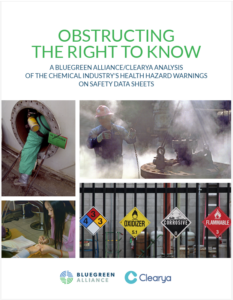 This report is a first-of-its-Scale Analysis of 650 Chemical Safety Data Sheets by Clearya and the BlueGreen Alliance. The report shows that workers and companies aren’t being warned of cancer risks and other dangers of the chemicals they are using
Released: December 15, 2022
Apollo Alliance
Apollo Alliance Green Manufacturing Plans
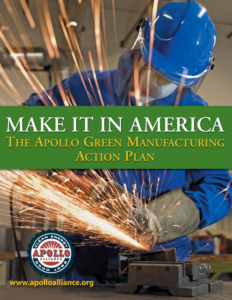 The Apollo Green Manufacturing Action Plans are a set of federal policy recommendations to spur domestic green manufacturing. These plans were developed through collaboration with representatives from academia, industry, labor, and environmental groups.
- National Green Manufacturing Action Plan (March 1, 2009)
- The Ohio Green Manufacturing Action Plan (January 26, 2012)
- The Michigan Green Manufacturing Action Plan (November 28, 2011)
- California Green Manufacturing Action Plan (November 13, 2012)
- Clean Transportation Manufacturing Action Plan (October 20, 2010)